How to choose the right kitchen knife
by Karine Lemoine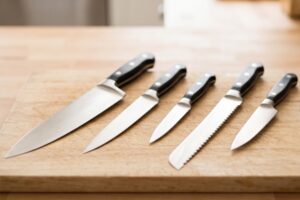
A good kitchen knife completely changes the way you cook: you cut faster, more precisely, and above all more safely. However, faced with knife shelves that all promise to be “the best”, it's easy to make a mistake.
You don't need an entire drawer of knives or the most expensive model to be well equipped. Here are the criteria that really matter, and the ones you can ignore without regret.
Sommaire
We take stock of the choice of material, weight, handle, and the budget for a knife that will really last.
Stainless steel or carbon steel?
The blade is the most important part of the knife, and two major families of steel share the market.
Stainless steelresists corrosion well and requires little maintenance: it is the most practical choice for daily use. On the other hand, it loses its sharpness a bit more quickly than carbon steel.
Carbon steelsharpens more easily and keeps an edge longer between sharpenings, butIt rusts if it is not dried immediately after use, and therefore requires more rigorous maintenance.
For a first knife or a hassle-free family use, stainless steel remains the safest choice. Reserve carbon for a second knife, once you're ready to take care of it.
The weight and balance in the hand matter more than the brand
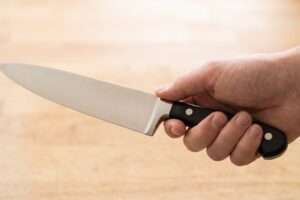
A good knife should bebalanced: not too heavy on the blade (tiring to handle), not too light (less control over the cut). The best test is to take it in hand before buying, if possible.
Hold the knife by the handle, with the blade pointing forward: if the balance point is around the blade/handle junction, that's a good sign. A knife that “tilts” too much to one side will be less pleasant to use on a daily basis, even if it cuts very well on paper.
If you can't test in store, give preference to reviews that explicitly mention the grip rather than the only edge right out of the box.
The handle: wood, plastic or composite resin
The handle has a direct influence on comfort and safety of use.
- Solid wood:warm and pleasant in the hand, but more sensitive to humidity and needs to be oiled from time to time to avoid splitting.
- Plastic:economical, water resistant, but can get slippery with greasy or damp hands.
- Composite resin (Pakkawood, etc.):a good compromise, the appearance of wood with the water resistance of plastic.
Regardless of the material, check that the handle does not slip in your hand, even if it is slightly wet.: it is a criterion of safety, not only of comfort.
Should you buy a knife set or one piece at a time?
Knife sets sold in blocks seem economical, but they often contain several pieces that will almost never be used.
A good, universal chef's knife is enough for the vast majority of daily tasks(see ourGuide to the different types of knivesto know which ones to add next according to your real needs).
It is better to invest in 2 or 3 good quality knives (chef, office, bread) than in a set of 10 inexpensive pieces that will lose their sharpness in a few weeks.
What is the budget for a good knife?
A good chef's knife is usually found on an average budget: beyond a certain minimum price, the difference is mainly due to the finish, the brand and the longevity of the cutting edge, not the ability to cut properly.
An expensive knife that is poorly maintained will cut worse than a simple knife that is properly sharpened.Regular maintenance (see oursharpening and maintenance guide) often has more impact on the end result than the purchase price.
Our tips for choosing the right knife
►Test the grip before buying
If possible, go to the store to hold the knife in your hand rather than only buying it online on photo.
►Avoid sets with too many pieces
Better 2-3 knives of quality as a set of 10 pieces that cannot all be used regularly.
►A knife, even a simple one, must be sharpened regularly
The sharpness counts more than the price: a well-sharpened, cheap knife often cuts better than an expensive, blunt knife.
►Check the warranty and the availability of parts (sharpening in the workshop)
Some brands offer a sharpening or blade replacement service: a real plus in the long term if you plan to keep the knife for several years.
In summary, the right knife is not necessarily the most expensive one, but the one that corresponds to your grip, to your real use, and that you will be ready to maintain regularly.
Do not hesitate to leave a comment!
For more information and to receive our news, follow us on social networks!
Comments on How to choose the right kitchen knife