How long does grated cheese keep?
by Karine Lemoine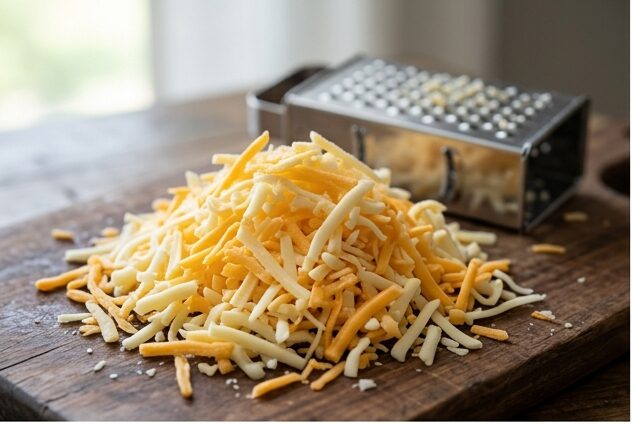
You have just opened a bag of grated cheese that has been lying around in the fridge for a while, and the question arises: still good, or heading for the trash?
Unlike a whole block of cheese, shredded cheese has a much higher surface area exposed to air. The result: it degrades differently, and often more quickly than you think.
Between industrial grated cheese in a bag, cheese that you grate yourself at home, and cheese that has been left open for a week, the rules are not the same.
Sommaire
We take stock of the shelf life in each situation, how to identify grated cheese that has turned, and our tips for making it last longer without taking risks.
How long does an unopened bag of shredded cheese last?
A bag of industrial grated cheese, still sealed and stored in the refrigerator, can generally be storedup to 1 month after the date indicated on the package, provided the bag has never been opened or pierced.
Grated cheese sold in bags often contains a bit of potato starch or cellulose, which is added to prevent the cheese slices from sticking together.This additive has no impact on food safety, it just plays an anti-caking role.
It is this same barrier (vacuum packaging or protective atmosphere) that explains why a closed bag lasts much longer than once opened.
And once the bag is opened?
As soon as the air comes into contact with the grated cheese, the countdown changes completely.
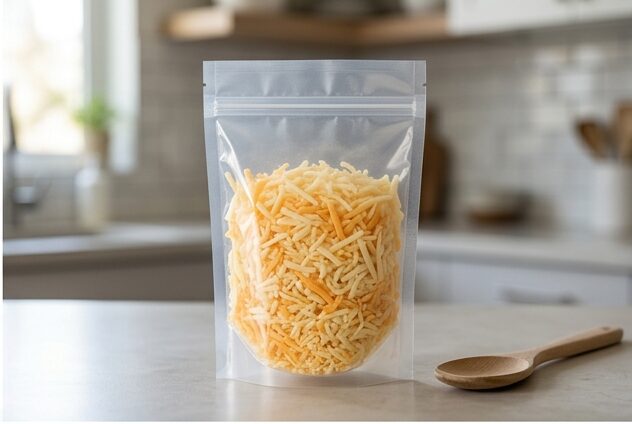
An opened and well-sealed bag of grated cheese can be stored for 1 to 2 weeks in the refrigerator.
After this period, cheese does not necessarily become dangerous overnight, but its texture degrades (it dries, hardens, sticks less well when cooked) and the risk of mold development increases significantly.
The most important thing: seal the bag tightly after each use, expelling as much air as possible, or transfer the cheese into an airtight container or freezer bag.
Home-made grated cheese: shorter shelf life
If you grate a piece of cheese yourself at home (countertop, Emmental, Gruyère...), the shelf life isshorter than for an industrial bag: allow 3 to 5 days in the refrigerator, in an airtight box.
The reason is simple: homemade grated cheese has no preservatives, no anti-caking agents, or vacuum packaging. It is directly exposed to the air and humidity in the refrigerator as soon as it is grated.
On the other hand, a whole piece of cheese, not grated, can be stored much longer: the surface in contact with air is much smaller than when it is crumbled into small pieces.
Our advice: grate only as much as you need for the recipe of the moment, rather than shredding an entire block in advance.
How do you know if grated cheese is no longer good?
There are a few simple signs to know if your grated cheese is still edible:
- Smell:a strong, sour, or ammonia odor that does not match the usual smell of cheese is a warning signal.
- Texture:Shredded cheese that becomes viscous, sticky, or stringy (beyond its normal texture) should not be consumed.
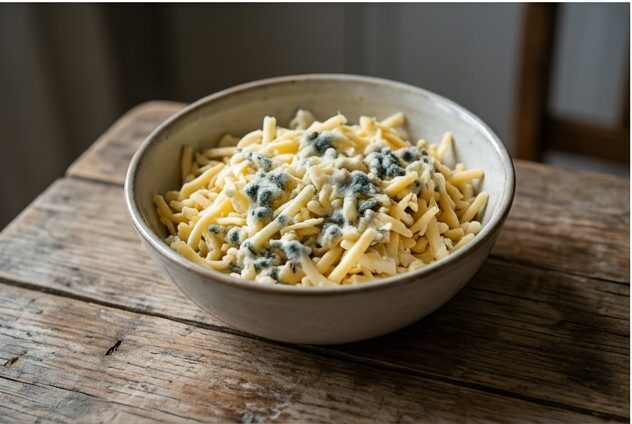
- Mold:unlike a block of hard cheese, where you can sometimes remove a small moldy area by cutting wide around it,A moldy grated cheese should be discarded in its entirety. The fine wires may have been contaminated by mold filaments invisible to the naked eye, spread throughout the bag.
- Color:unusual discoloration (gray, greenish, or black spots) is also a sign that should not be ignored.
Conversely, simply grated cheesedry or slightly hardened is not dangerous: it has just lost its softness and may be a little less pleasant to cook, without any health risk.
Can you freeze grated cheese?
Yes, grated cheese can be frozen very well, better even than a whole block of cheese in some cases, and it is a great option if you have bought or grated a too large a quantity.
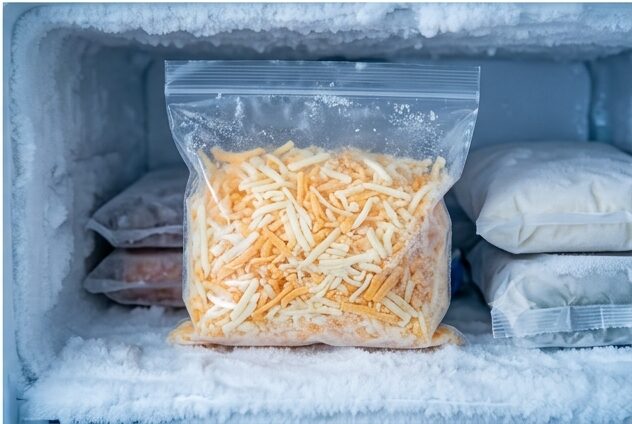
Placed in a freezer bag by expelling the air, or in an airtight box, grated cheese can be stored2 to 3 months in the freezerwithout significant loss of quality for cooking.
Once thawed, its texture is slightly more crumbly and it sometimes melts a little less creamy than fresh cheese.: it is therefore perfect for a gratin, a pizza or an omelette, less ideal for a cheese board or a pure tasting.
No need to defrost it before use in a cooked recipe: you can add it directly frozen to your dish.
Our tips for making grated cheese last longer
►Close the package tightly after each use
Expel the air out of the bag before resealing it, or use a bag clip. Air is the main enemy in the preservation of grated cheese.
►Avoid the refrigerator door
The door is the area in the refrigerator where the temperature varies the most with each opening.Instead, choose a shelf in the middle or bottom of the refrigerator, where the temperature is more stable.
►Do not leave it at room temperature for too long
As with most dairy products,Avoid leaving grated cheese at room temperature for more than 2 hours, the time after which bacteria can start growing more quickly.
►Freeze in small portions
If you are freezing a large quantity, break it up into smaller portions rather than a single large block: this way you only defrost as much as you need, without having to refreeze the rest.
In summary, the shelf life of grated cheese depends mainly on its condition: closed bag, open bag, or homemade grated cheese do not have the same shelf life.
When in doubt, trust your nose and your eyes: an unusual smell or texture is always better than a date on a package.
Do not hesitate to leave a comment!
For more information and to receive our news, follow us on social networks!
You might also like: Ultimate omelet guide and our homemade Croque Monsieur recipe.
Comments on How long does grated cheese keep?