Is hard anodized aluminum casserole safe for your health?
by Karine Lemoine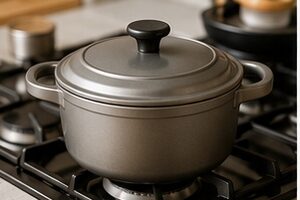
A hard-anodized aluminum casserole often comes up in lists of recommended cooking equipment, appreciated for its lightness and good heat conduction. But as soon as the word “aluminum” appears, a legitimate concern arises: can this metal migrate into food and present a health risk?
The answer depends largely on the treatment the metal has undergone. Hard anodization deeply transforms the surface of aluminum, and significantly changes its behavior in the face of heat and acidic foods.
Table of Contents
Here's how this treatment works, what the available data on aluminum migration say, and the precautions you need to know to use this type of casserole without worries.
What is hard anodizing?
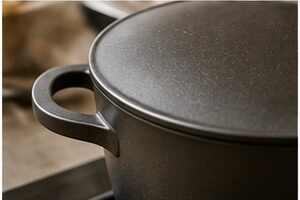
Anodizing is an electrochemical process that causes a layer of aluminum oxide to grow on the surface of aluminum that is much harder and denser than the raw metal. In the case of “hard” anodization, this layer is further reinforced, resulting in a surface close to the hardness of ceramic, resistant to abrasion and light scratches.
This oxide layeracts as a barrierbetween the metal core of the casserole and the food. It is this barrier that is changing the game in terms of food safety, compared to aluminum that is simply polished or raw.
Does aluminum migrate into food?
Raw aluminum is known to be sensitive to acidic foods: tomato, vinegar, citrus fruits or wine can, over time, encourage a slight migration of metal particles into the dish. It is for this reason that untreated aluminum is used less and less for the long cooking of acidic preparations.
The oxide layer obtained by hard anodization is chemically much more stable and much less reactive than bare aluminum. The migration measurements carried out on this type of coating show quantities much lower than those observed with raw aluminum, in proportions that remain, under normal conditions of use, below the vigilance thresholds retained by the health authorities for dietary exposure to aluminum.
In what cases should you remain vigilant?
The weak point is not the anodized aluminum itself, but itspossible degradation. An anodized layer that is deeply scratched, for example due to metal utensils or an abrasive pad, can reveal the underlying metal in places. It is only in this case that the risk of migration meets that of raw aluminum.
An anodized casserole in good condition, without deep scratches or visible chips, maintains its barrier function and remains considered safe for common culinary use, including for slightly acidic preparations.
Our tips
►Choose soft utensils
Wooden, silicone or nylon spoons and spatulas preserve the anodized layer much better than metal, which can eventually mark it.
►Avoid abrasive products and sponges
Gentle cleaning, with hot water and dishwashing liquid, is sufficient in the vast majority of cases and protects the surface durably.
►Inspect the condition of the casserole regularly
If the coating has deep scratches or areas where metal is clearly visible, it is reasonable to consider replacing it for prolonged acid cooking.
Used in good condition and maintained without excessive abrasion, a hard-anodized aluminum casserole does not pose a particular problem for daily health.
You can also read:Whether old aluminum frying pans are safeandWhether stainless steel is good for your health.
Do not hesitate to leave a comment!
For more information and to receive our news, follow us on social networks!
Comments on Is hard anodized aluminum casserole safe for your health?