Is a cast iron casserole compatible with a ceramic stovetop?
by Karine Lemoine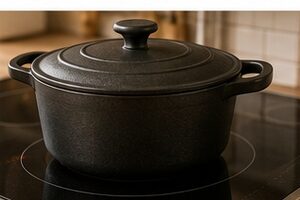
Cast iron has a reputation for being puncture-proof, but what about when used on a ceramic stovetop? The question comes up often among people who have just installed this type of plate.
A cast iron casserole can be used on a ceramic stovetop, provided you respect certain precautions related to the weight and surface of the utensil.
Table of Contents
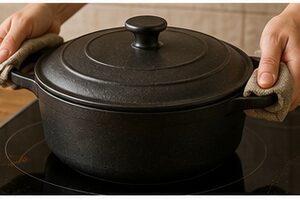
Here is what you need to know about the compatibility of cast iron with ceramic glass, the risks of scratches and the right actions to adopt on a daily basis.
Cast iron, a material compatible with ceramic glass
Unlike some induction stovetops that require a specific magnetic base, a ceramic stovetop works by transmitting heat in direct contact with the surface. Cast iron, which distributes heat homogeneously, is therefore ideally suited thermally.The real point of vigilance is not the heating, but the physical contact between the bottom of the casserole and the glass.
The risk of scratches on the plate
The bottom of a cast iron casserole is often raw, sometimes slightly irregular or sandblasted. If it is made to slide on the plate, even for a few centimeters, this contact may be enough to permanently mark the glass surface.Never slide a cast iron casserole onto a ceramic stovetop, it must always be fully raised to move, place or remove it.
The weight of cast iron, a factor not to be overlooked
A full cast iron casserole can weigh several kilos. This significant weight, combined with an impact or an abrupt installation, can weaken the glass in the long term, especially if it already has a micro-crack invisible to the eye. It is therefore preferable to place the casserole gently, with both hands, rather than letting it fall onto the plate from a certain height.
Check the flatness of the bottom
Over time, some cast iron cookers may deform slightly, especially if they have experienced severe thermal shock. A base that is no longer perfectly flat will have unstable contact with the plate, which can create uneven pressure points and increase the risk of scratches during handling. A simple visual check, with a casserole placed on a flat surface, makes it possible to verify that the bottom has not warped.
Our tips
►Lift, never slide
Always take the casserole by its two handles when putting it down or moving it, even for a short distance.
►Keep the bottom clean and dry
Residues of hardened fat or small particles stuck under the casserole can scratch the plate with the slightest movement. Wipe the bottom dry before each use.
►Avoid sudden thermal shocks
Never put a very hot cast iron casserole on a cold surface, and avoid passing it directly from the refrigerator to an already hot plate, which can weaken the cast iron itself.
In practice, a cast iron casserole goes very well with a ceramic stovetop, as long as you lift it rather than slide it and ensure that its bottom is clean.
You can also read:How do you care for a Dutch oven casseroleandHow to take care of your cast iron casserole.
Do not hesitate to leave a comment!
For more information and to receive our news, follow us on social networks!
Comments on Is a cast iron casserole compatible with a ceramic stovetop?