Do you have to cook a non-stick pan? What you need to know
by Karine Lemoine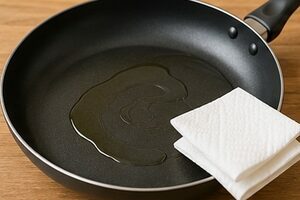
The “cooking” reflex comes from pig iron and carbon steel, where a thin layer of polymerized oil protects the metal and makes cooking easier. Many wonder whether to apply the same treatment to a modern non-stick pan.
The answer is more nuanced than it seems: the way a non-stick coating works has nothing like that of pig iron.
Table of Contents
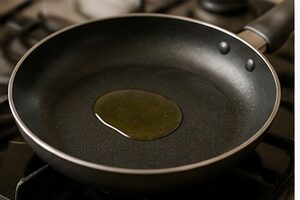
Here's why conventional oil panting isn't what manufacturers recommend for nonstick, and what to do instead.
Why doesn't oil panting apply here
Casting cast iron or carbon steel involves heating several layers of oil until they polymerize and form a protective patina on the bare metal.A non-stick coating, whether made of PTFE (Teflon type) or ceramic, does not need this patina since the non-stick effect comes directly from the coating itself, not a layer of accumulated oil.
Heating oil in successive layers on this type of surface therefore brings no benefit, and may even leave sticky and yellowish deposits if the oil burns at high temperature, which damages the appearance and effectiveness of the coating.
What manufacturers actually recommend
Before the very first use, most manufacturers simply indicate to wash the pan in hot soapy water, to dry it well, and then, for some models, to pass a very thin film of oil with a paper towel before the first cooking. This step is mainly used to ground the surface, not to create a durable protective layer as on cast iron.
On a daily basis, a little bit of fat is still useful for cooking itself and to limit the wear of the coating over time, but it is not cooking in the literal sense.
What really preserves the coating
What really extends the life of a non-stick pan is above all how it is used on a daily basis: avoid the heat too high, never heat the pan empty, use wooden, silicone or plastic utensils rather than metal, and wash it by hand with a soft sponge rather than with an abrasive sponge or in the dishwasher.
A frying pan left to cool before washing also prevents thermal shock, which can deform the bottom and create areas where the coating peels off more quickly.
Our tips
►Don't try to replicate cast iron cooking
A modern non-stick does not need layers of polymerized oil: this gesture, useful on pig iron, does not contribute anything to this type of coating and can even leave sticky residues.
►Follow the manufacturer's instructions to the letter
Recommendations vary between brands and coatings: some advise a light film of oil before first use, others do not. The instructions remain the most reliable reference.
►Prefer low to moderate heat
Non-stick coatings degrade more quickly at high temperatures. Cooking at low or moderate heat preserves their properties much longer than systematic high heat.
On a modern non-stick frying pan, cast-iron oil frying is useless: it is daily use, low heat and suitable utensils, that really protects the coating.
You can also read:How to maintain your non-stick frying pansandHow do you know when to throw away a nonstick skillet.
Do not hesitate to leave a comment!
For more information and to receive our news, follow us on social networks!
Comments on Do you have to cook a non-stick pan? What you need to know