How to Care for Your Non-Stick Pans?
by Karine Lemoine 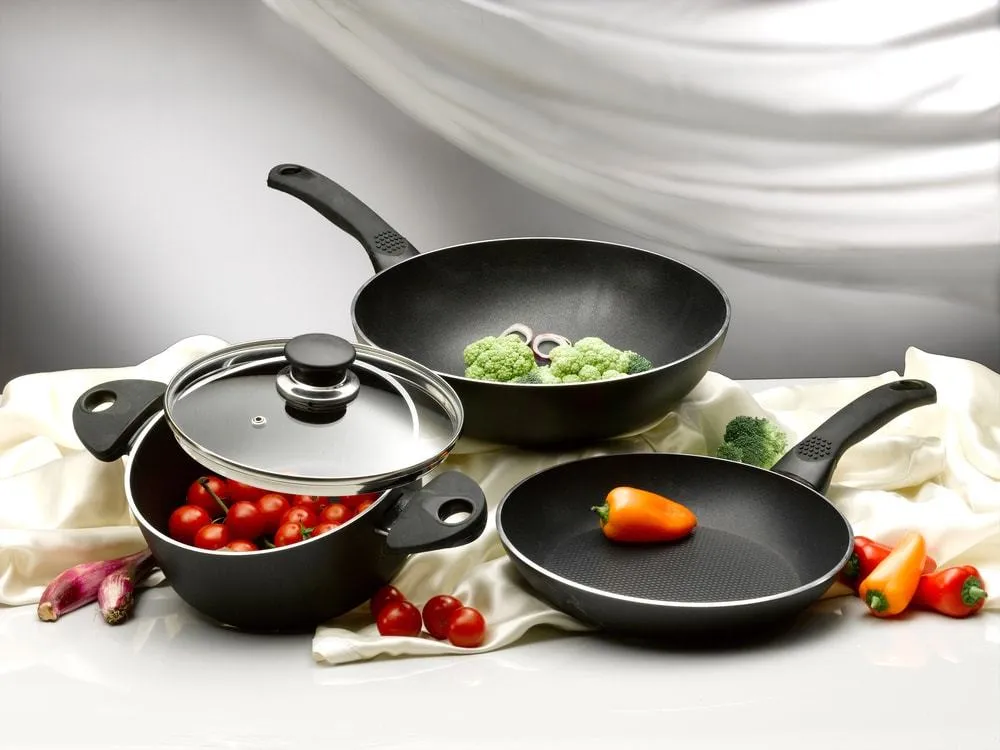
The non-stick pan is one of the essential utensils for cooking. It can be found in almost every household. It has become very popular over time because of how easy it is to maintain and to cook with.
We've all had the experience at least once in the kitchen of burning our food, either through a moment of carelessness or because of unsuitable equipment.
Whether you're a beginner or more experienced, when you use a non-stick pan to cook your dish, it's normally almost impossible to burn your food.
The non-stick coating applied to the surface of the pan was designed to prevent food from ending up burnt and inedible.
In addition to being easy to cook with, cleaning a non-stick pan is really much simpler and saves you time when washing up.
Generally, you'll find an aluminum-coated material that has the advantage of being lighter unlike iron or copper pans.
However, the downside of the non-stick pan is that it remains fairly fragile and can get damaged very quickly.
Frequent use combined with poor use and a lack of maintenance can cause serious damage to the pan and make it unusable.
Here are a few tips to properly maintain your non-stick pans.
What is a non-stick pan?
We all know how frustrating it can be to try to fry eggs, omelets, or crepes but be unable to control them because of a sticky pan or skillet. This doesn't just cause frustration, it also wastes your time.
On top of that, the quality of the food will be affected, which doesn't encourage you to improve in the kitchen or gain confidence in your cooking.
Today, on the market, you'll find pans with a non-stick coating made of ceramic or Teflon.
The non-stick pan, which is the most common type, has an aluminum base, an excellent conductor of heat, and a thin coating layer more commonly known as Teflon.
Everyone knows the internationally renowned Tefal brand. The name Tefal is actually a contraction of TEFlon and ALuminum.
This Teflon process was patented in the 1950s and led to great success for Tefal pans.
The coatings used on the surface of non-stick pans have evolved over the years.
In the past, it didn't take long for the surface of a non-stick pan to become deformed.
The loss of non-stick properties happened fairly quickly, generally within a few months of first use.
Are non-stick pans harmful to your health?
Teflon was seriously controversial in the 2000s, and Tefal, the market leader in non-stick pans, was heavily penalized.
Originally, in its manufacturing process, Teflon required a chemical component called PFOA (or perfluorooctanoic acid) which was challenged and banned due to its danger to our health.
All manufacturers of non-stick pans had to rethink their product specifications.
In principle, there is no longer a risk of finding this substance on our plates since standards have since evolved.
Manufacturing advances have made it possible to produce more advanced non-stick pans that stand the test of time and have no impact on our health.
Manufacturers are quick to highlight the PFOA/PTFE-free label on the packaging of coated pans.
Products are now made from better quality metals and have become more durable. It is now possible to use non-stick pans at both high and low temperatures.
We are currently in a trend of eating more healthily, being told to watch our cholesterol, and to eat less sugar and less fat.
The non-stick pan has the particular feature, thanks to its non-stick property, of reducing the sometimes generous use of fats.
Most French people obviously love cooking with butter, and it's practically written into our genes.
Indeed, food cooked with this equipment doesn't need as much butter or oil, it's true. Some will even tell you that you can do without it entirely.
However, with a bit of common sense, cooking food in the pan with low water content and no prior greasing isn't necessarily going to be appetizing or give a great result.
It turns out that greasing the pan remains essential, and it's better to adjust the amount of fat depending on the dish you are preparing.
If, for example, you are searing a good rib steak that will cook in its own fat, greasing beforehand won't be essential.
On the other hand, if you are searing turkey, which is a fairly dry meat with a milder flavor, you'll need to grease the pan well beforehand to prevent it from sticking and to add a bit of flavor.
Just to be clear, we're not telling you to go overboard with fats, but simply to use the right amount, and only the cook, the user, remains in control of their cooking and can adapt to different types of preparation.
Even if the coating is non-stick, that alone isn't enough.
Fat adds flavor to your dishes, and by greasing a non-stick pan, you clearly increase its durability and lifespan.
The slicker the surface, as it should be, the easier it will be for you to cook your food while avoiding damage to the coating.
There are of course other factors that will help you improve the durability of your pans, which we will cover next.
But the first instinct is still to grease the bottom of the pan to prevent it, over time, from sticking because of food resting directly on the coating, which is more likely to burn than anything else.
What causes a coated pan to lose its non-stick qualities?
1. Damaged coating
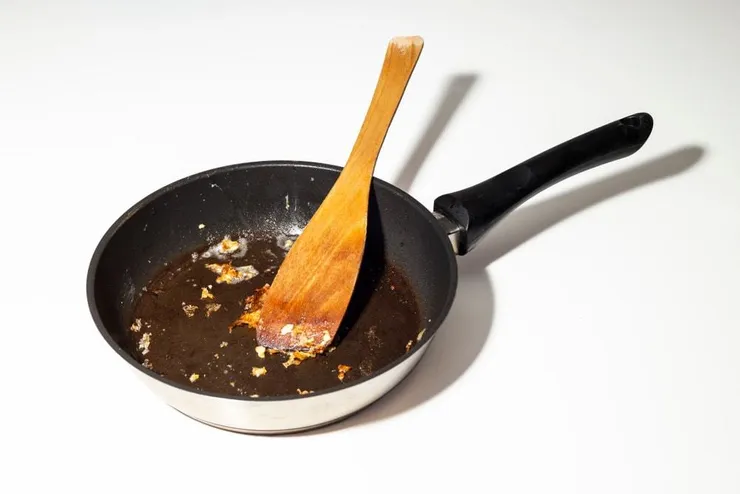
You can tell a coating is damaged when scratches appear. This means part of the coating has come off and is exposing the metal, with tiny amounts of iron, aluminum, or even lead that could end up on your plate.
This amount intensifies with use and simply becomes harmful to our health.
Also, when there are burnt residues left behind, the pan will inevitably stick and prevent food from making even contact with the surface, which results in uneven cooking.
2. The pan warping
We've all found ourselves one day with a warped pan, partly from age but mostly from how it was used.
Some people, for example, are in the habit of running the pan under the tap as soon as cooking is finished.
This is indeed not a recommended practice, because contact between a still-hot pan and cold tap water creates a thermal shock that can warp the material.
Cooking will then no longer be even.
3. Overheating
We immediately think of induction cooktops, which have the magic ability to heat up a pan quickly.
Let's put the booster function aside right away!!! It can seriously damage your cooking equipment.
When heating the pan, go gradually over medium heat. Yes, the booster function saves time, but at what cost!
4. Lack of fat
Many people think there is no need to grease a non-stick pan since it is already coated for that very reason.
Using zero fat is ideally very good for your health, but not for maintaining the pan.
Greasing the pan helps maintain its non-stick capability.
This helps avoid carbon residues on the coating and results in a pan that is easier to clean.
5. Machine washing
The best way to preserve the non-stick properties of your pan is to avoid washing it in the dishwasher.
You might say that hand-washing is extra work and takes more time. If the manufacturer states the pan is dishwasher-safe, why do the opposite?
Well, quite simply, some dishwasher detergents can be fairly harsh and, over time, risk weakening the coating.
And between us, if you follow the usage and care recommendations, washing up will actually be very easy.
8 tips for maintaining the coating of your non-stick pans
►Use non-metallic spatulas to avoid scratching the coating.
►Avoid cutting food directly in the pan.
►Be sure to grease the pan before adding your ingredients.
There is no need to heat the oil at the same time as the pan, as you risk overheating the oil, which then becomes harmful at a certain temperature.
►Avoid overheating the pan and heat it gradually.
►Be careful not to leave the pan empty on the heat for too long.
►Let the pan cool down before washing it.
►Washing your pan by hand is better.
►For washing, regular dish soap is more than enough to remove grease.
By adopting the right habits and proper use of your pans, you will be able to improve the lifespan and performance of your non-stick pans.
You're now ready to make great omelets, cook up delicious sauteed vegetables, or cook your delicious fish like a chef!
Feel free to leave a comment!
For more info and to get our latest news, follow us on social media!
FACEBOOK - INSTAGRAM - TWITTER
Image source: Freepik
Frequently Asked Questions
What is the right temperature to cook my food at?
In the tips above, I shared a handy trick for knowing when the pan is at the right temperature. Just flick a few drops of water onto the heating pan, and it is ready when the water droplets bead up and dance around.
Can I grease my pan while it is cooking?
Ideally, you should grease the pan before even heating up your food. This helps prevent food from sticking.
My pan's coating is scratched, can I still use it?
Unfortunately, you should avoid using it and throw it away, as it can be harmful to your health. All the tips I have shared should help you take better care of your pans going forward.
What type of oil can I use to grease the pan?
There is no absolute rule when it comes to choosing an oil to season a non-stick pan. Favor vegetable oils (olive, sunflower, rapeseed), which are unsaturated fatty acids, better for your health when used in moderation!
Comments on How to Care for Your Non-Stick Pans?