The different types of vegetable cuts in the kitchen
by Karine Lemoine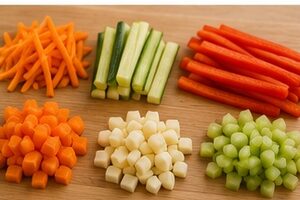
Julienne, Brunoise, Mirepoix... cooking recipes often use technical vocabulary to refer to how to cut vegetables. What do these terms mean exactly?
Each cup corresponds to a precise shape and size, chosen according to the use: quick cooking, presentation, texture in the mouth or extraction of aromas in broth.
Table of Contents
Here are the main vegetable cuts used in cooking, with a short definition for each.
Cups into sticks and cubes
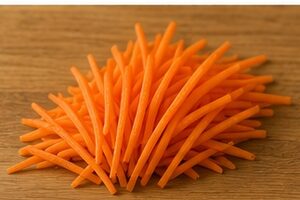
- Julienne: thin sticks about 3 to 5 cm long and 1 to 2 mm thick, used for raw carrots or leeks or quickly sauteed.
- Brunoise: very small cubes with a side of about 2 to 3 mm, often obtained by first cutting a julienne and then cutting it again.
- macedonia: medium-sized cubes, about 5 mm, commonly used for cooked vegetable blends.
- Mirepoix: coarser and irregular cubes of carrots, onions and celery, intended to flavor a stock or sauce before being removed or mixed.
Thin cuts and strips
- Chiffonnade: thin strips obtained by rolling leaves (salad, basil, cabbage) before slicing them, for a regular result.
- Mincé: thin slices cut lengthwise, common for onions or mushrooms.
- Vichy: thin slices, in reference to the Vichy carrot, cut perpendicularly.
The cups for broths, stocks and presentation
- Peasant: fine and irregular pieces, in triangles or squares, typical of traditional soups.
- Planter: sticks slightly thicker than julienne, about 4 mm in cross section, used for side vegetables.
- Crushed: coarsely cut pieces, often used for tomatoes intended for a sauce.
- Tourné: vegetable sculpted by hand in a regular shape (like a barrel for potatoes), rather reserved for presentation cooking.
Our tips
►Adapt the cut to the cooking time
The thinner the cut, the faster and more homogeneous the cooking is: a brunoise cooks in a few minutes, while a mirepoix needs to simmer for a long time to deliver its aromas.
►Keep regular sized pieces
The same cut should result in pieces of uniform size throughout the dish, to ensure uniform cooking.
►Choose a suitable knife
A paring knife is suitable for small, precise cuts such as brunoise, while a chef's knife is more suitable for julienne or mirepoix.
Behind these technical names are simple guidelines: the size and shape of the cup determine the cooking, texture, and final presentation of the dish.
You can also read:How do you cut green onionsandThe taste of fern sticks.
Do not hesitate to leave a comment!
For more information and to receive our news, follow us on social networks!
Comments on The different types of vegetable cuts in the kitchen