What types of cooking best preserve the nutrients in food?
by Karine Lemoine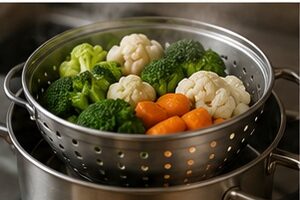
Steam, oven, frying, boiling: the cooking method chosen directly influences the quantity of vitamins and minerals that arrive on the plate.
Some nutrients are fragile in the face of heat or dissolve in cooking water, while others, on the contrary, become more easily assimilated after cooking.
Table of Contents
Here's what you need to know to choose the cooking method that's best suited to the preservation of nutrients, depending on the food.
Nutrients sensitive to heat and water
Vitamins are divided into two main families: fat-soluble vitamins (A, D, E, K), which are fairly resistant to cooking, and water-soluble vitamins (vitamin C and B vitamins), which are much more fragile.The latter degrade with heat and especially dissolve in cooking water., which explains a large part of the nutritional losses observed according to the method used.
The cooking time and the amount of water used often play a greater role than the method itself: the longer a food cooks and the more it is in contact with a large volume of water, the greater the losses.
Steam cooking, a safe bet
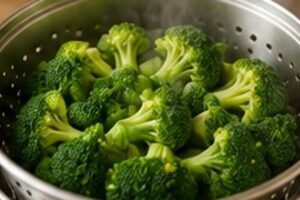
Steaming is one of the methods that best preserve nutrients. The food is never immersed in water: water-soluble vitamins therefore do not have the opportunity to dissolve in it. Cooking is generally rapid and homogeneous, which also limits the degradation associated with the duration of exposure to heat.
For this reason, steam is often recommended for green vegetables, which are rich in vitamin C and folate, two particularly fragile nutrients.
Boiling: the most fragile method
Conversely, boiling a vegetable in a large volume of water is one of the most effective ways to lose water-soluble vitamins. Some of the vitamin C and B vitamins migrate into the cooking water, which is then most often discarded.
Cook in as little water as possible, covered, and for a limited timesignificantly reduces these losses. Vegetable cooking water, when stored for broth or soup, also makes it possible to recover some of the dissolved nutrients.
Baking and frying: different effects depending on the nutrients
Cooking in the oven, without water, limits the loss by dissolution but exposes the food to heat that is often higher and longer, which can degrade certain vitamins that are sensitive to heat. However, it remains interesting for liposoluble nutrients.
Frying, by providing fat, can promote the absorption of fat-soluble vitamins (A, D, E, K) and certain antioxidants such as beta-carotene. However, it exposes the food to high temperatures that degrade some of the vitamins that are sensitive to heat, and it changes the nutritional composition by adding fats.
Also note: some nutrients become more available after cooking, such as lycopene from tomatoes or beta-carotene from carrots, as heat facilitates their release from plant cells.
Our tips
►Choose steam for vegetables rich in vitamin C
Broccoli, spinach, bell peppers or cabbages benefit from being steamed rather than cooked in water, to limit the loss of vitamin C and folate.
►Reduce the time and volume of cooking water
Regardless of the method chosen, cooking for a short time, covered, with little water, always limits nutritional losses.
►Do not always throw away cooking water
It contains some of the vitamins and minerals in the food: it can be reused in soup, sauce or broth.
There is no single cooking method that is ideal for all foods: steam and short cooking with little water remain generally the most favorable choices for maintaining nutrients.
You can also read:The best cooking methods for vegetablesandThe difference between convection oven and conventional oven.
Do not hesitate to leave a comment!
For more information and to receive our news, follow us on social networks!
Comments on What types of cooking best preserve the nutrients in food?