Cooking R for Rice
by Karine Lemoine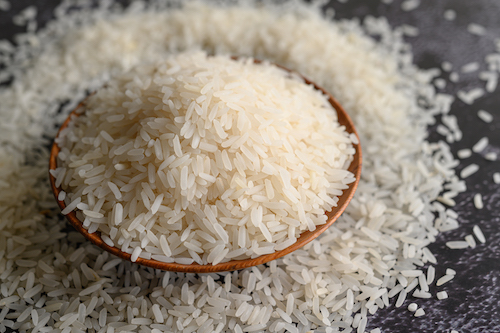
Rice is a must in our kitchen! Round, white, black, complete, we all have rice in our cupboards in different forms and varieties.
In France, we consume every year, 4.5 kg of white rice per person.
Rice is a food rich in slow sugars that we accompany with meat, fish or vegetables.
It is cooked in many ways and many dishes go perfectly with these small grains of rice.
Rice is perfect for a good blanquette de veau or a Basque chicken, especially since it is easily soaked in the sauce.
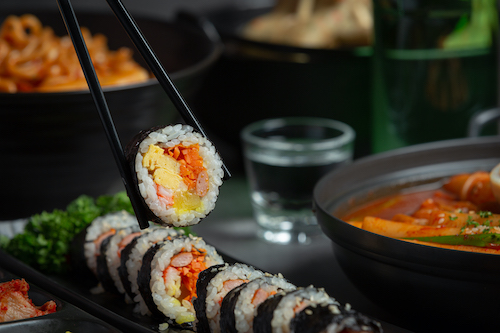 It can be eaten as a savory or sweet dish, in the form of rice cake for dessert..
Rice is used to prepare alcoholic beverages such as Sake in Japan, a rice spirit produced by fermentation or Mijiu, a traditional Chinese beer brewed from sticky rice.
It can also be purchased in the supermarket in the form of rice cake, rice flour, rice milk or even rice vinegar.
The biggest consumers of rice are mainly China and India, where locals consume rice as a staple food in their dishes..
Just like us French people, with the bread that is always served at the table, rice is part of Asian and Indian culinary traditions.
The foods that people like to eat all over the world are Cantonese rice, curry rice, stir-fried rice or even makis and sushi.
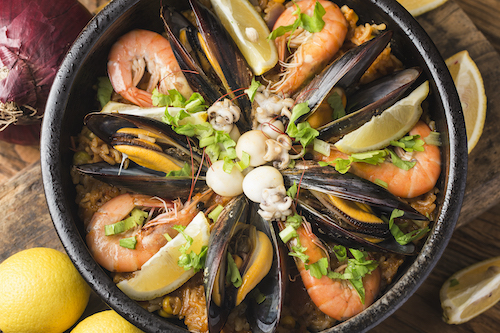 The dishes that are cooked in Europe based on rice are Paella in Spain, risotto in Italy or even curry on Reunion Island.
There are a huge number of varieties of rice, the choice is wide on supermarket shelves.
So to find your way around, is one rice better than another? What are the benefits of rice? How do you cook it?
We explain all this to you in detail and we share with you a 5-Spice Raisin Rice Recipe simple and requires few ingredients.
From rice cultivation to the plate
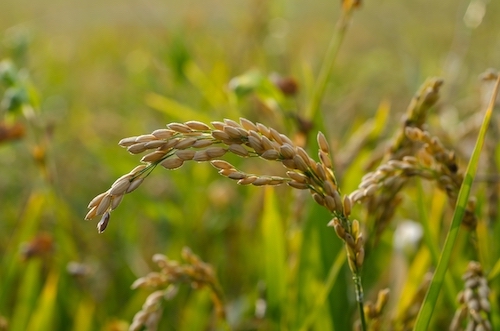
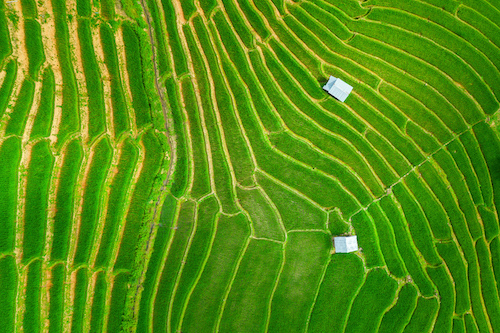
Rice is a cereal that is similar to the ear of wheat except that it Can be grown in an aquatic environment in rice fields, the huge flooded fields.
On a single ear of rice, there are hundreds of rice grains, it's magic!
Native to Asia, over time, it has been domesticated in order to withstand bad weather and to obtain better productions.
It is The world's first cereal in our diet and alone, it represents 20% of the world's food needs.
There are over 120,000 varieties of rice in the world, it's huge and we're constantly developing new ones.
In France, rice is grown and harvested in Autumn, only once a year.
Mostly cultivated in the Bouches du Rhône; we know well Camargue rice labeled IGP (Protected Geographical Indication).
French production represents only 3% of world production so to complete our assortment, we call on neighbors, Italy and Spain among others, which are the main importers of rice in Europe and also Asia and India.
RICE AND ITS PROCESSING STEPS
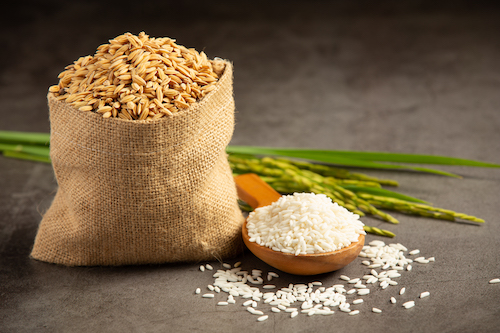 From the cob of harvested rice to the plate, rice can undergo several transformations.
- At the first post-harvest stage, we obtain The rice called paddy which is not yet consumable as it is since it contains its external protective envelope called the ball.
- Once the protective envelope is removed, we obtain Brown rice or brown rice Who keeps the second envelope called The pericarp or the sound.
- Then, by the action of polishing and laundering, the transformation is finalized by obtaining the white rice.
All these steps are done naturally and without chemicals.
The different varieties of rice
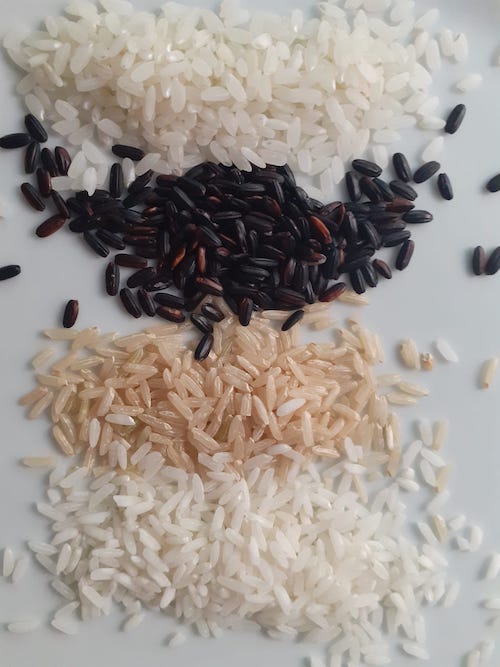
Depending on the shape and length of the grains, a distinction is made between:
- Round grain rice almost as wide as it is long (4 to 5 mm long and 2.5 mm thick). It contains a lot of starch. The grains clump together when cooked. It is used to make rice pudding, sushi or paella.
- Medium grain rice (5 to 6 mm in length) is shorter and plump than long-grain rice. It contains a lot of starch and sticks when it cools.
- Long grain rice (6mm and more) light and non-sticky, has good cooking properties.
This classification is also accompanied by a classification on taste criteria:
- Glutinous rice: It is sticky and very well suited for successful sushi and makis. You will find the “Sushi Rice” label on the packaging to help consumers see more clearly all the varieties offered.
- Fragrant rices,The most well known: jasmine rice, basmati rice or Thai rice.
- Risotto rice
TWO FAMILIES OF RICE: Indica and Japonica
There are 2 main families of rice:
► The indica
It represents 80% of world production, it is the largest rice family.
They are relatively hard long grain rices.
In Iran, Sardi rice which is only grown in Iran.
In Asia, Thai jasmine rice.
In India, Basmati rice the most sold in the world, the five star or the supreme basmati rice. Basmati rice has a deliciously fragrant taste and it is an aroma that is completely natural.
► The japonica
It represents 20% of global production, 95% of which is produced in Europe. Rice grains come in a variety of shapes: short, long, oval or round. They absorb a lot of water when cooked and swell, releasing starch, making them much stickier.
This rice is very suitable for risottos, sushi or even rice pudding cake.
In America, The Brown Short or The Sweet Rice.
In Japan, sushi rice, for example The Shiragiku.
In Spain, Bomba and Bahia, traditionally used for paellas. Its grains have the capacity to absorb the equivalent of their volume in juice while remaining firm when cooked.
In France, Camargue rice The best known, red rice, which is a brown rice, tender and soft and owes its color to its bran shell. Don't worry, its color is completely natural. There is no transformation or coloring, everything is natural.
Camargue, today, can produce all types of grains: round, long, whole rice, rice colored red, black or sushi rice.
In Italy, The Arborio, The Carnaroli or The Vialone Nano, appreciated for its fondant, its creaminess and its lightness.
We can also find The Baldo, a must in Italian soups like Minestrone.
There is black rice, also called” Riso Venere ” (Venus rice). It is a fairly sticky brown rice that is characterized by its deep black color.
This color changes to dark purple after cooking. It brings a real touch of color to the plate! In taste, it is reminiscent of hazelnuts.
In Portugal, The Carolino (Ariete and Euro) or L'Agulha , a more elongated grain.
Cooking rice
Rice cooking temperatures vary from one rice to another because of its absorption capacity.
It is a food that is generally used to cook in boiling water and then simmering like cooking pasta. Perhaps this cooking seems much easier.
It's not necessarily the best way to cook rice. In any case, Asians would be surprised to see the way in which we practice. Throwing water out of the rice would be like removing some of the starch, the nourishing substance found in rice.
Brown rice has a fairly long cooking time of 45 minutes. Because of its rawer nature, because it has retained its bran film, rice has more difficulty absorbing. As a result, it allows you to make stewed dishes.
The quickest rice to cook is the white rice that can be cooked in 5 minutes.These have undergone an oven treatment, i.e. they have already been pre-cooked with steam in order to speed up their cooking for consumption.
As a general rule, White rice takes 20 minutes to cook once the water boils.
Cook your steamed rice without skipping the cooking process
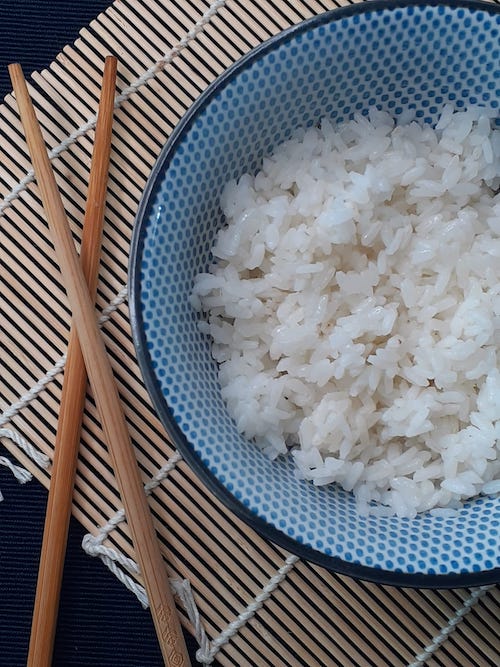
Can successfully cooking rice be random for some? After following these few steps, it will no longer be a secret for you!
If you don't have an appliance to cook rice or don't have it at hand, a simple stewpot with a lid will suffice for you to get deliciously good and well-cooked rice!
I am sharing with you my daily cooking routine that was given to me by a Taiwanese friend.
The steps to follow:
- Rinse the rice well several times to remove the cloudy water.
- Add the rice to the stewpot and fill with water up to 2 times the volume of rice in water.
- Bring to a boil, once it is boiling, place a lid on top to prevent the water from evaporating.
- Lower the heat slightly to prevent water from escaping and cook for 10 minutes.
- After 10 minutes, remove the stewpot from the heat without removing the lid.
- Let it rest for 25 minutes. You can open the lid and your rice is ready!
Of course, there are other ways to cook rice. Surely you have heard of the Pilaf rice, creole rice or the famous risotto.
How do you avoid sticky rice?
If you don't rinse it before cooking it, the rice will stick too much all the time.
Before you heat your rice, Rinse it several times to change from cloudy water to clearer water.
White rice is made up of starch in the vast majority and if you don't get rid of the starch on the surface of the rice, It will form a sticky gel. So your rice will stick!
Rice: a good health ally
Rice is mainly loaded with carbohydrates, that is a very good slow sugar intake to balance our plates. It is very satietogenic and at the intestinal level, it is well tolerated.
Rice in general represents approximately 130 calories per 100 grams, once it is cooked.
Contrary to what you might think, it does not make you gain weight. Rather, it is the quantity eaten and the side dishes that necessarily increase the number of calories.
Rice is also a good source of gluten-free carbohydrates, so it is recommended for people who are allergic to gluten.
Is one rice better for your health than another?
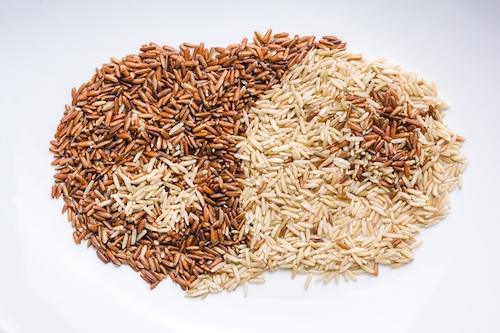 Black rice has a nutty flavor. or red rice from Camargue are whole grains of rice. They retained their bran membrane that was richer in fiber and iron.
Wholemeal rice is therefore much more nutritious..
If you opt for brown rice, it is best to Choose organic brown rice which has not undergone intensive treatment loaded with pesticides.
Do you want to try a variety of rice that you don't know yet?
Now that you know more about rice, you can make lots of recipes in peace because rice is a good ally in our meals.
Rice is nutritious and can be combined with many ingredients. If you haven't tested it yet, cook and enjoy our delicious recipe for rice pilaf with grapes and 5 spices!
Do not hesitate to leave a comment!
For more information and to receive our news, follow us on social networks!
Image source: home cooking and freepik
FAQ
How long does rice keep?
Dry rice can be stored for one year in an airtight jar away from humidity.
Does rice really contain arsenic?
Because of its cultivation in immersion, rice absorbs minerals and also possible heavy metals contained in groundwater, especially Arsenic, which is the source of health risks. However, this concentration of Arsenic is mainly found in the bran of rice, its protective shell. If you eat brown rice that preserves this bran shell, it is highly recommended that you choose organic brown rice. White rice, on the other hand, is safe to eat.
How can I not burn my rice while cooking?
If you follow our advice in this article to cook your rice, it's almost impossible to miss it. Cooking rice is actually quite quick because with the method we use, the rice cooks for only 10 minutes compared to other methods. During these 10 minutes of cooking, you just need to be careful to respect the time.
Comments on Cooking R for Rice