Does glass go in the oven?
by Karine Lemoine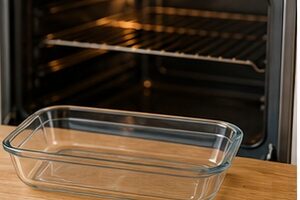
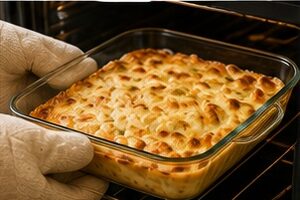
A glass dish lying around in the cupboard, a desire for golden gratin, and the question that arises at the last moment: can this glass really go in the oven without risk?
Not all glasses behave the same when exposed to heat. Some are designed to withstand large temperature differences, others can crack or even burst under thermal shock.
Table of Contents
Here's how to tell which glasses are suitable for cooking, why some glasses break in the oven, and the precautions to follow to cook without unpleasant surprises.
Borosilicate glass, designed for heat
Borosilicate glass, known historically as Pyrex in Europe, contains boron oxide, which gives it avery low coefficient of thermal expansion. Concretely, it deforms very little when the temperature changes, which makes it able to go from the refrigerator to the hot oven without breaking in most cases.
It is the reference material for gratin dishes, mussels, and baking containers that are explicitly sold as “oven-safe.”
Tempered glass, a different resistance
Tempered glass, often made of heat-treated soda-lime glass, gains in mechanical resistance to impacts and scratches, but its resistance to sudden temperature changes remains more limited than that of borosilicate. Some current cookware uses this type of tempered glass and is well designed for the oven, as long as the manufacturer's instructions are respected, in particular on temperature differences to avoid.
The main thing is toRefer to the manufacturer's descriptionrather than the appearance of the glass, which does not allow us to guess its exact nature.
Ordinary glass, a real risk in the oven
A drinking glass, a canning jar, a decorative dish, or any container that does not mention “ovenproof” is generally ordinary glass, not designed to withstand significant temperature variations. Under the effect of heat, the different areas of the glass expand unevenly, creating internal tensions that can go as far as cracking or bursting, sometimes abruptly and without warning.
Thermal shock is particularly to be feared when a cold dish, coming out of the refrigerator, is placed directly into an oven that is already hot, or when a hot dish is placed on a cold and humid surface.
Our tips
►Always check the manufacturer's name
The base or packaging of the dish usually indicates whether it is oven, microwave, or freezer compatible. It is the only really reliable indication.
►Avoid sudden temperature changes
Even a dish intended for the oven cannot handle going directly from the freezer to an oven that is already preheated to a high temperature.
►Never reuse a jar or drinking glass
These containers are designed for use at room temperature or cold, never for cooking.
Only glass specifically designed for cooking, borosilicate or tempered according to the manufacturer's instructions, can safely go in the oven.
You can also read:Whether you can put a plate in a toaster ovenandIf you can put a pizza box in the oven.
Do not hesitate to leave a comment!
For more information and to receive our news, follow us on social networks!
Comments on Does glass go in the oven?